Ten years later
Some things have changed. While other things keep re-appearing. And suddenly this blog becomes active again today. Why being absent for 10 years, what did I do, what brings me back? It doesn’t matter. Let’s taste the ambiguity of the communicative network once again. Let’s try the force of the writing routine. And some things will keep re-appearing, like the clouds, like emptiness, like dance moves.
Une minute de danse par jour 01 12 2018/ danse 1418 (One Minute of Dance a Day). from Nadia Vadori-Gauthier on Vimeo.“4:36 p.m., Capucines boulevard, Paris 9e. The yellow Jacquets protest against precarious living conditions. and tax injustice, leads to outbreaks of violence and confrontations with the police.”
***
Ten years ago some officials in Greece had the insight to place a huge and peaceful green Xmas tree in Syntagma Sq, Athens, in front of the Parliament’s view:
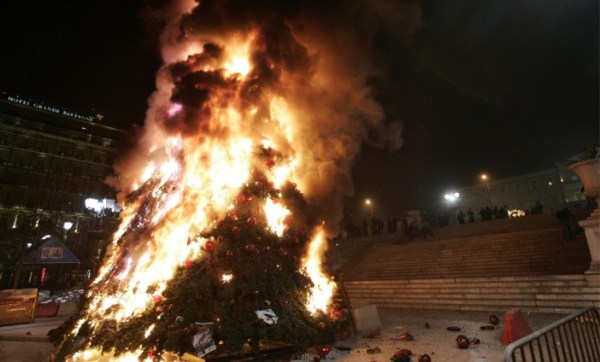
© REUTERS/John Kolesidis 2008
“Used copies of The Cultivation of Christmas Trees can still be found and are very much worth the hunt — or the trip to the library” according to this well researched BrainPickings article.
There are several attitudes towards Christmas,
Some of which we may disregard:
The social, the torpid, the patently commercial,
The rowdy (the pubs being open till midnight),
And the childish — which is not that of the child…
For whom the candle is a star, and the gilded angel
Spreading its wings at the summit of the tree
Is not only a decoration, but an angel.

At the beginning there was a publisher’s idea to gather and produce holiday-themed verses and drawings for a poetry pamphlet series, which could be sent to clients instead of Christmas cards, and which could still be sold to the general public.
So, above, you can read T. S. Eliot’s starting verse for his sixth, and last, poem that he contributed to this project in 1954; the pamphlet was greatly illustrated by Enrico Arno. (The whole poem with all its drawings can be found by a mere internet search).
***
Bodies and Images
Tell me why you decided to be at the gilets jaunes protest last Saturday.
I decided to go because I saw pictures from the movement. I was in the United States, in Providence, Rhode Island, and in those pictures I saw very poor people, people like my mother, people like my father, exhausted people, extremely poor people. I was able to read it on their faces, because I know those people. I recognized, suddenly, a body, in the noblest sense of the term. A body that I’m not used to seeing in the media. And I felt that these images were crying out to me.
There was the emergence of the kind of body that we never see, and, along with it, the kinds of words that we never hear. People are saying, “I can’t manage to feed myself, or my family. Christmas is coming up, and I can’t buy presents for my kids.” And, for me, a sentence like that is so much more political, so much more powerful, than all of this discourse about “the Republic,” the “people,” “coexistence,” “democracy.” What does any of that mean? These grand concepts that don’t really reflect anything. Nothing real, nothing corporal, at least.
Can you describe the kinds of bodies that you’re talking about?
It’s the body of social exclusion. It’s the body of poverty. It’s the body of people who are living in precarity, people from the North of France, or from the South of France, who don’t have money, who come from the kinds of families that haven’t gotten an education in five generations—families like mine. I grew up in a family of seven, and we had to live on seven hundred euros a month. Five kids and two adults. Maybe you have to really come from that world to immediately identify it.
Actually, when I started to write books, it was because I had the impression that these kinds of bodies were never depicted. And, when I was a kid, my parents, and especially my mother, always said, “No one is talking about us. No one cares about us.” One of the most violent feelings we had was this feeling of not existing in the public discourse, in the eyes and voices of others. It was like an obsession. There was not one day where my mother didn’t say, “No one is talking about us. The whole world could care less.” And so, for example, elections were the moment when she tried to fight against that kind of invisibility. Voilà.
Bodies, images, and social movements. Christmas time 2018. This was an extract from An Interview with the Novelist Édouard Louis on the Gilets Jaunes Movement: To Exist in the Eyes of Others [published by Alexandra Schwartz in The New Yorker, 14/12/2018]
***
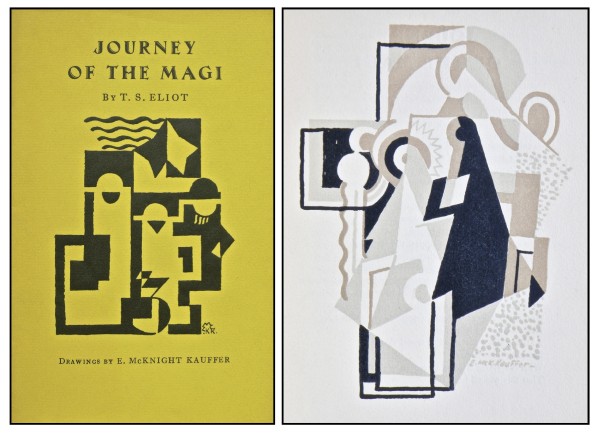
If in the Cultivation of Christmas Trees T. S. Eliot invites us to cultivate a sense of wonder, in his very first poem for the same pamphlet series, which was The Journey of the Magi (written much earlier in 1927), he offers a dramatic monologue whereby alienation and a feeling of powerlessness prevail.
The journey does not offer wonders, but a tedious and painful nature, a complaint. A whisper is constantly attached to the ears: “this was all folly”; eventually reaching the out-of-time realisation of the intertangled facets of rupture and destruction, (whose destruction? what if ours – what do we do?), in the advance of historical change.
…were we led all that way for
Birth or Death?
Sensibility

© Henri Cartier-Bresson (Pierre Bonnard, assis 'Deville' 1944)
Bonnard used to say “what are you after?.. why this instant?.. why press the shutter just then?”
I just answered “why did you just put this stub of yellow?”
He laughed. We knew sensibility cannot be explained.
pinhole is cool

For all those enjoying the pleasures of a pinhole camera, or even better, for those who always wanted a reason to try, click here for a Corbis link to five cool and funky designs of a pinhole camera. Download and print them for free :)
Don’t forget to check out the gallery as well. Are you surprised by the power of the pinhole photography? To add one more example, I have included here a photo by Steve Gosling (below), which was the winner of the ‘Places’ 2006 competition by the journal Black & White Photography (Issue 66)

© Steve Gosling
This photograph made by a pinhole camera revealed the ‘eerie formations’ of Yorkshire’s Brimham Rocks – formed of a tough sandstone known as millstone grit, a task that was not easy to capture with a standard camera.
According to the photographer, “it’s very difficult when using a standard camera to find a composition that works, because the rocks are very scattered. But the pinhole camera accentuates the texture of the rocks in the foreground in a way that a standard camera wouldn’t.” He also explains that the long exposure, because of the pinhole’s f/138 aperture, and the resulting movement in the tree and the clouds gives a picture a lift.
think different: the new american
The night when Barack Hussein Obama was elected as the new U.S. president, adding new meanings to the American identity, I prefer to look at some photographs from the past. And then accompany them with few comments of scepticism.

Lee Friedlander (Paul Tate, Lafayette, Louisiana 1968)
fast & changing world (part I)
Keith Loutit employed and combined ’tilt-shifting’ and time-lapse photography in order to create the video below. The method of tilting the lens of the camera helped him to control the orientation of the plane of focus, and select an area of focus that deviates from the usual case, which is parallel to the camera. A large aperture was also used to achieve a very shallow depth of field. The images were manipulated so that they look like photographs of a miniature scale model and, given the high vantage point too, the scene seems much smaller than it actually is.
Unleash your potential
There is a time when not knowing what day it is feels very wrong, particularly when you end up buying the stale bread from the shelf. But most other times, it seems just fine.
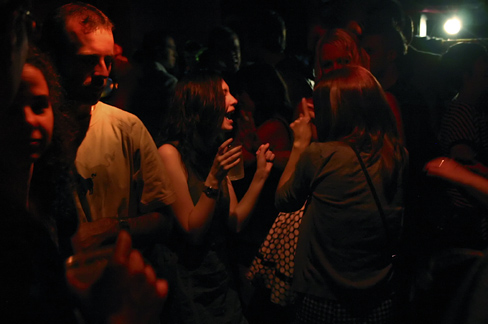
© Christos Stavrou (untitled, 2008)
There is a poem by Charles Bukowski claiming that…
there are worse things than
being alone
but it often takes decades
to realize this
and most often
when you do
it’s too late
and there’s nothing worse
than
too late.
There is a time when, despite being surrounded by so many people, someone feels their own body freezing out and the spirit turning into a statue from inside out. Suddenly, this time, one cannot simply move away or keep walking backwards and forwards, eagerly compensating for the time running out. In fact, those with the higher antennas might be the first ones left out; amateurs, angels, and professionals altogether… All this despite, again, that we all need – in the end – a certain level of emotional superficiality… And despite how everyone is aware that the sound of petrified legs hardly echo the most wanted and abused word at the moment, ‘friend’.
How could a body like this have a big love anyway!
***

© Christos Stavrou (untitled, 2008)
colour

© Anne Turyn, 12-17-1960, from 'Flashbulb Memories' (1986)
“Colour expands a photograph’s palette and adds a new level of descriptive information and transparency to the image. It is more transparent because one is stopped less by the surface – colour is more like how we see. It has added description because it shows the colour of light and the colours of a culture or an age. While made in the 1980s, the palette of this image by Anne Turyn seems to date the picture a generation earlier.”
From ‘The Nature of Photographs‘ by Stephen Shore (Phaidon 2007) p.18.
***
Yet, while I was recently watching The Genius of Photography (Episode 4) it came as a pleasant surprise to hear how William Eggleston was described as unreadable. This is the photographer of course, who brought serious colour photography into the mainstream art world (see for example a review by Photo Book Guide).
Highlights from the Archives
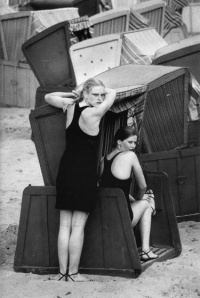
"Always happy" (10.07.2007). Exploring the relationship between photography and authority. The GDR authorities insisted that their citizens should always be depicted smiling. Read more...

"The right background: new freedoms" (11.09.07). The need to choose the 'right' visual background reveals the increasing anxiety felt by those representing our malleable reality, from the Taliban to the White House. Read more...
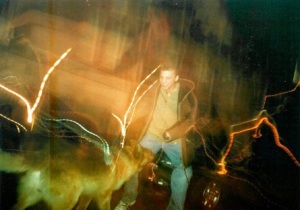
"More photography = more democracy?" (15.06.07). Recent violent incidents in Hyde Park, Leeds' student area, raised questions about controversial methods of policing and the alleged democratic potential of photography. Read more...
But how photography managed to become critical and subversive within GDR’s political setting? Read more in the post “Do not refreeze” (27.07.2007). Considering how our context and definitions are different now, could photography claim a similar social and political role?
monochrome
My secret black economy is collapsing since your white words have not arrived yet. (I left the road behind and walked by the stream). A Freudian self-centred view, a stage in the process of development for Melanie Klein.

Untitled © Christos Stavrou
You-knee-tea Day
…as some of my friends call it, or ‘Unity Day’ if you prefer its official name, is an annual event taking place in Hyde Park, Leeds.  According to the organisers’ website, it is “a day of celebration for the local community to show the best of whom we are. The community had lost a local Pub, the ‘Newlands’ through riots in 1995, which attracted intense national media coverage and this led to a negative portrayal of the area which we as a community had to come to terms with ourselves. Hyde Park Unity Day is an association of individuals who give their time and talents freely to create a day celebrating our area and our diversity.”

Hyde Park Unity Day is a series of events leading to a 12 hour day of "celebration for the community and visitors of Leeds 6". Photos from last Sunday 17 August 2008. (All photos & text © Christos Stavrou. All rights reserved)
The terror of mundane theatricality

The entrance hall of the Museum of the Revolution © Philippe Chancel
We know all about terror in the West. It is imprinted well deep in our bones and histories.
We have inflicted it to all the ‘new’ lands, to the people we named Indians, all around the African coasts with their free slaves. We instilled it all the way down to our own soul and our own populations; then we re-discovered it in the external enemy.
art & culture

Couple of months ago a friend asked me, what is culture?
Few days later on, he offered a cold beer and asked me again. I hesitated to reply both times. I think that he was wondering about those early humans in caves drawing hunting scenes on the walls. Of course, I thought, this was culture. All systems of ideas and practices; all different beliefs and norms are culture(s), like any school text writes… Now, however, if someone attempts to make distinctions between ‘high’ and ‘low’ culture, as if some type of culture is not really culture, things start to look tricky. But honestly, this distinction is no more than a cultural imposition itself. Incidentally, but not surprisingly, one kind of distinction which is traditionally loved by both conservative and left speakers…
Culture is nevertheless relational. I wanted to point out this. It makes sense in relation to something else and other… thus, we may need to talk about cultures rather than culture… But then I forgot all about his question, lost – as usually – in the multiple threads starting out of another little and ‘simple’ question… I am simply not sure what culture is…
Only recently, I came across a published editorial by Ivan Mecl, which made me think about it again and which I want to share here. It was published in the latest issue of Umelec, an international art and culture magazine (English version, Vol. 12, 1-2008, published by Divus.cz)
All photographs accompanying this article are taken during one of my recent ‘cultural’ trips to London.
“We work like old people, yet we behave like children more than ever before. We surround ourselves with mobile miracles, and therefore we have no idea what we are dealing with. We try to live in safety, and yet we do not know what it means to be safe. Many of us have lost time, but acquired “things.” We love “things” and their names sound nice to us. We love them, but they do not love us. We are impressed by their being changed, and unhappy by their loss. We are unhappy and with no time to spare from unrequited love, and always on the move.”

Tate Modern: 'The moment art changed forever'... But which moment exactly was that? Now, then, when?
the fork
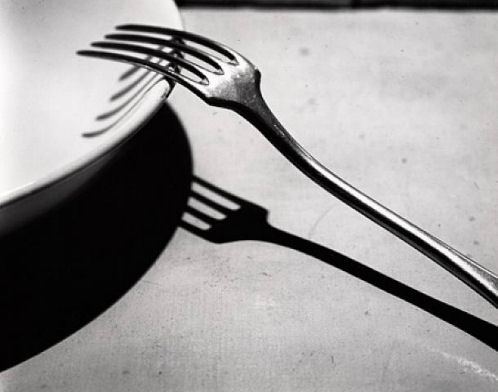
A photograph of a fork by Andre Kertesz (Paris, 1928). A fork and a plate are transformed, from two simple and overlooked items of everyday life into a new reality – a mysterious experience, a formal poetry.
An image that easily captures attention and stays long in memory. Maybe because we didn’t expect such a performance from the mundane and the taken for granted around us. Kertesz has masterly simplified here into an abstraction that take us by surprise. Maybe because we sense – reluctantly – that the fork hides so much about us. Things which reflect forms of social life and ways of individual self-discipline, entailed in the development of modern manners.
“My wife remembers vividly her first encounter with Norbert in Cambridge when he talked about the history of the fork and used this simple clue to analyse the process of civilization” wrote A. Glucksmann in an introduction to Norbert Elias’s work.
‘Candidate with a cane’
A news photograph of F.D. Roosevelt, circulated in 1928, four years before he was first elected as a president, shows a well-dressed man in a confident posture. It is visually demonstrating his ‘good standing’ to the electorate. But otherwise, it could easily pass as an unremarkable photograph among many other official photos of politicians. ‘Candidate with a cane’ could be the generic title as Sally Stein remarks in a recent article (2006).

But on closer inspection, the viewer might discover a well hidden second cane which provides support to Roosevelt’s impaired body. Since 1922, he was not able to stand or walk without external form of help.
Fundamentalisms
There is one video – linked in my last post – that keeps coming back in my mind. I am talking about that tv clip showing how the sculptor Cosimo Cavallaro got attacked by a representative of a religious group, who in the name of their version of Catholicism and rigid moral order, launched a series of bullying tactics and threatening acts against everyone associated with Cavallaro’s work: a statue of Jesus made by chocolate.
The scandalous point for that religious group was not its chocolate nature of course. It was its anatomically correct representation.
I’m glad that Cosimo Cavallaro has eloquently exposed the morally and conceptually empty stance of his attacker during the TV interview. Yet, if the latter believes that this is “one of the worst assaults against Christian sensibilities ever”, (as reported in the news), an assumption which he then conveniently uses as a pretext in order to justify a wave of violent reactions; should we overlook with disdain his behaviour for obviously manipulating reality and ends, or start worrying about the state of our political thought and the undermined role of art?
I am wondering how to perceive this whole incidence. For example, as evidence of some remaining parochial figures which keep providing a source of identification for easily-led authoritarian personalities? Or, given their apparent capacity to terrorise, to threaten with violence or enforce economic boycotts, is this evidence of the continuing political power and effectiveness of extreme right-wing groups and their discourses?
For many, this represents a kind of anachronism within modern society. Certainly, an example of its current contradictions. Many sociologists, such as Giddens, have viewed these groups in terms of modern fundamentalisms. They try to defend tradition but in such a rigid way that they refuse public dialogue and examination of their ‘truths’. Nevertheless, as it is asserted, we live in times and places where truths have to be decided. Consequently, these fundamentalist movements, following religious, national or other traditional discourses, could often lead to violence, as in our example here.
Violence is in the air, no doubt about it. Although, I would say that this violence arises, not only from the non-dialogic position of such traditional groups (of religion, nation, sexuality, gender, etc), but also from the emotion-based and non-rationally understood reactions of the threatened individuals which comprise them. (In other words, their intolerance might not be responsive to rational approaches, and it seems to me this is the case here too).
Now, whether these individuals of fundamentalist groups face real or actually imaginary threats to their beliefs and identities, which they seem capable to push them into insular and defensive positions, could be the next big question. In other words, is there really any threat to Christian religion by a chocolate statue made of the anatomically correct features? Or, some groups and individuals use such instances as a pretext to cover up their psychological inability to face bigger destabilising questions and their social difficulty to coexist with others in a democratic society? I leave it to everyone to think about it, whether being one of those individuals or not.
chocolate Jesus
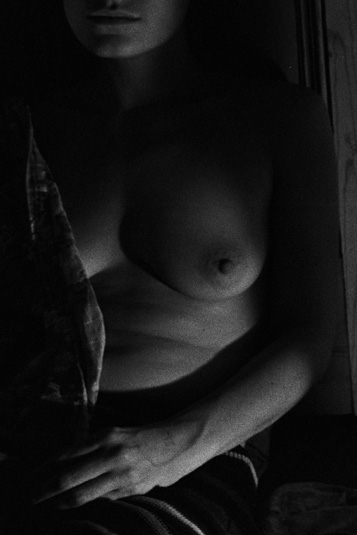
Untitled photograph (nude 2) by Christos Stavrou © 2008
I wish I could send you a chocolate Jesus, maybe that abandoned one which they failed to exhibit last year in New York… But in the end, I guess you’ll be equally satisfied with few mint chocolates in a box and a photograph of an almost chocolate body… It is my easter present of course. Chocolates and one sudden thought, if my bath is running hot enough, make me realise that you are always around here.
* * *
“How did beauty begin? Earth-cult, suppressing the eye, locks man in the belly of mothers. There is, I insist, nothing beautiful in nature. Nature is primal power, coarse and turbulent. Beauty is our weapon against nature; by it we make objects, giving them limit, symmetry, proportion. Beauty halts and freezes the melting flux of nature.” (from the book Sexual Personae by C. Paglia © 1990).
* * *
fear & paranoia

Soon after I took this photo above, standing by the entrance of Leeds University, and as I was waiting for a sudden wave of rain to pass – among shiny bikes and a man whose posture and reflection had intrigued me… well, very soon after that a security guard came out from his box running quickly towards me.
Rolling (the gaze)

The Rolling Exhibition began as a simple photograph taken while Kevin Connolly was skating down a backstreet in Vienna some time ago. Kevin kept travelling balancing his torso on a skateboard, and now, after rolling through the streets of 31 cities in 15 countries, he exhibits what he collected: the stare.
About a kiss and a bullet (authenticity & social relations)
the kiss
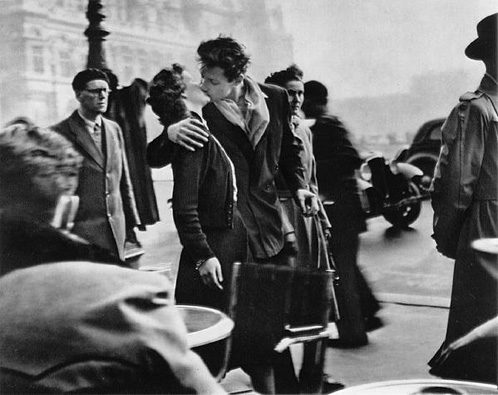
How does it feel to know that one of the most romantic images ever made was staged? The famous ‘Kiss by the Hôtel de Ville’ by Robert Doisneau, captured in Paris in 1950, was no other but a manufactured image. Alas, this was revealed by its creator himself in a court trial in the 1990s when, in mid of controversy, Françoise Bornet, a former actress and the woman who was featured with her boyfriend in the photo, sued Doisneau for $18,000 and a share of the royalty in the image.
Her case was dismissed. Doisneau died the next year in 1994. But in the end, few years later, Ms. Bornet sold her original print of the photograph for over $200,000 at an auction (BBC News 25/4/2005) while the rights still remain with Doisneau’s agency.
So does it still feel an iconic image to you, a quintessential Parisian image of passion, a symbol of romantic spontaneity and desire?
At twelve

“In the early fall, I drank coffee with several generations of the Conner family, the close air of their kitchen settling across my shoulders like a shawl. I explained what I was doing and, as so often happened, their initial suspicion gave way gradually to caution and then to curiosity and a guarded acceptance. They agreed that I could photograph Kelly.
At dawn at the first day of hunting season they called where the deer were beheaded and hung. As I set up the camera, Kelly appeared, buttoned up, accompanied by her mother, her aunt and uncle, her grandparents, cousins, and a few other family members. Arrayed behind me, they remained watchful and intent.
As I pulled her jacket back, to separate her white-shirted figure from the darkness of the shed, I thought I might have heard a murmur. After few minutes I relaxed enough to identify the prevalence of the V shapes in the scene and without thinking I asked Kelly to spread her legs. This time the murmur was audible, but I could see that the picture was complete.”
Text and photograph (above) by Sally Man; from her book ‘At Twelve. Portraits of young women’ (© 1988, Aperture Foundation).
Henri Cartier-Bresson’s scrapbook
A major photographic exhibition is coming to the North. Representing the first half of Henri Cartier-Bresson’s career (which spans from 1932 to 1946), a photographic material which was carefully selected, printed and mounted to a scrapbook by himself after the World War II, will be shown in the National Media Museum in Bradford from 7th of March to 1st of June 2008.
As the museum’s website reports, “these photographs documented both his extensive travels and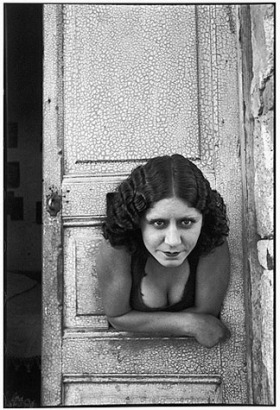 his encounters with Surrealism and modern art. They were conceived as an initial selection for a major exhibition at the Museum of Modern Art in New York, a show that would catapult Cartier-Bresson onto the world stage and bring him international recognition. All the original photographs have now been brought together for a new exhibition, showing for the first time in the UK.” (photo left: Henri Cartier-Bresson, Mexico, 1934)
The story about the scrapbook’s making entails few very interesting twists. During World War II, and following Cartier-Bresson’s capture by the Nazis, the curators of the Museum of Modern Art were making arrangements for a posthumous exhibition of his work. But Henri, after three years in prison camps and two unsuccessful attempts, he managed to escape in 1943 and then survived in hiding. Few years later, he found out with pleasure about the MoMA plans and decided to collaborate and curate the exhibition himself, bringing 300 self-made prints glued in a scrapbook to New York!
the art of driving
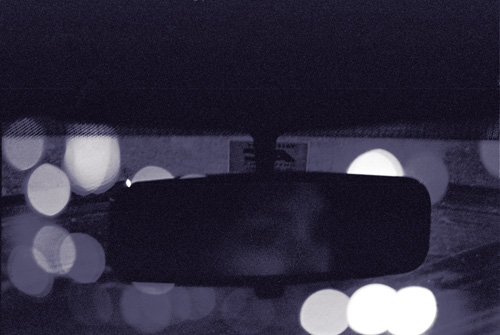
deconstructed
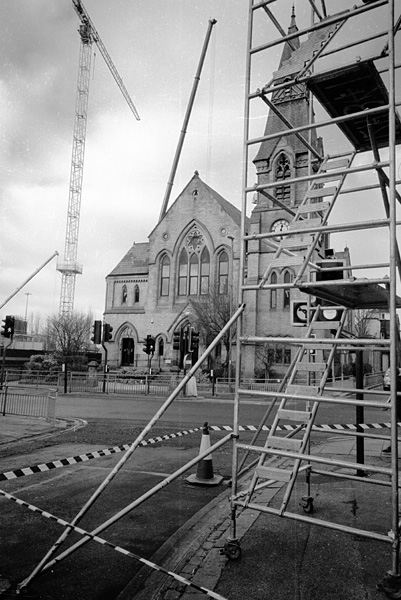
Leeds under construction. The city deconstructed.
Photograph by Christos Stavrou © 2007. All rights reserved
Robert Frank’s spectators
I opened a classic book tonight, The Americans by Robert Frank (1958). A friend left it here with couple other books before Christmas. I went downstairs to search for it. I was left with Robert Frank’s spectators.
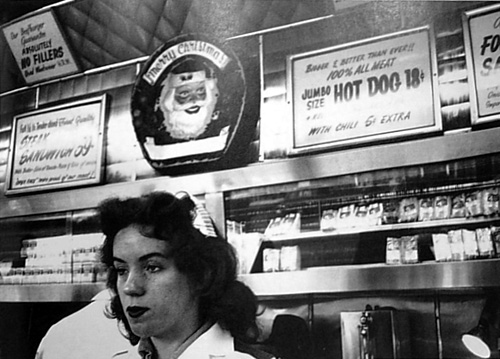
In page 37 a young girl working in a cafe or a similar place, is staring towards an unseen space at the left. It could be anywhere in America in the 1950s, when Frank went on the roads with his camera – in fact, the book does not provide any caption for this photo.
performance & interpretation
Despite my unfortunate absence for few weeks, and now just by the last day of January, here is the first post of the month and the year… The most exciting thing recently meeting my senses, which is no less than an omen of those promising and welcoming things to come.. So…
Let the new year begin!
‘Dissemblance en série’. Montage vidéo de ma dernière production chorégraphique présentée en avril 2007 à l’Agora de la danse. (‘Serial Dissimilarity’. Contemporary dance choreography presented at Studio de l’Agora de la dance, Montreal, april 2007).
Interprètes: Julie Bessette, Cathy Bourgoin, Caroline Carreau, Caroline Charbonneau, Gabriel Doucet, Marie-Pière Durocher et Audrée Hotte.
Musique: Les 4 saisons – L’été – Presto • Antonio Vivaldi.
Choreography and vdeo by Pascal Desparois.
“It was a piece about feeling different and not fitting in, and realizing that everyone felt the same way. It also talked about our trueselves vs the projected image of our selves and the disfunction between the two (the reason for the mirror & the videos).” Pascal Desparois

 Think in Pictures